Scope gaps surface late
Underground limits, backflow and standpipes often sit between the written scope, the spec and the civil sheets. Nobody owns them until the job is already priced.

Fire sprinkler takeoff, estimating & bid review
Not a symbol counter for every trade. WOLF1956 reads the drawings, Division 21 specs, NFPA 13 basis and your written scope before a number is set, then hands back four documents: a Design Scope, an editable Estimate, a clean Proposal and a marked-up drawing set.
First project free · Plans from $249.99 per seat / month + $29.99 membership · Prices published, no sales call · Cancel anytime
Illustration using a fictional sample project.
The problem
Underground limits, backflow and standpipes often sit between the written scope, the spec and the civil sheets. Nobody owns them until the job is already priced.
An addendum revises one floor plan and not the fire protection concept. A ceiling note contradicts the scope letter. Those conflicts become change orders.
A missing water test or an unconfirmed code edition quietly becomes an assumption. WOLF1956 keeps unknowns visibly marked as unknown.
What we check
Counting what’s drawn is the easy part. The money in a fire sprinkler bid sits in what the drawings don’t show yet. Every WOLF1956 review works through the same fire-protection checklist.
Light, Ordinary Group 1 and 2, or Extra Hazard, set area by area per NFPA 13. Storage and anything unclear is flagged for the AHJ, not quietly assumed.
NFPA 13 · by areaCounted by room, ceiling type and head type: pendent, upright, sidewall, concealed. Open-to-structure areas and finished ceilings are kept separate.
Heads · type · ceilingZone risers, valves, FDC location and the backflow device the system actually needs, plus who owns each piece: you, the site contractor or the utility.
Riser · FDC · DCDA / RPZFlow test data recorded with its date and source, or marked missing. Fire pump and standpipe triggers are checked against building height and the adopted code.
Flow test · pump · NFPA 14Adopted NFPA 13 edition, IFC and local amendments, Division 21 specs, addenda and your written scope, cross-checked. Conflicts become draft RFIs you decide to send.
Div 21 · addenda · RFIsHow it works
Architectural or schematic drawings, specifications, addenda and your written fire protection scope. Completed sprinkler drawings aren’t required for a preliminary budget.
Before anything is priced, the package is checked for building area, occupancy, heights, construction and available water-supply data. If it’s too thin to budget, you hear that first.
Every finding points back to a sheet, a spec section, a code source or a recorded assumption. Code and AHJ items that can’t be confirmed stay flagged instead of being guessed.
Design Scope, Estimate, Proposal and marked-up drawings, ready for you to adjust, put on your letterhead and send.
Interactive demo
No form, no call, no sales rep. Open the working demo and watch a complete fictional sprinkler package go from source documents to all four outputs. It runs in your browser, and nothing is uploaded or collected.
Fictional sample project · runs in your browser · sample checks written for this package, not a live read of your documents
Loads on request (about 2.6 MB)
What you get
Real pages from the fictional sample project used in the demo.
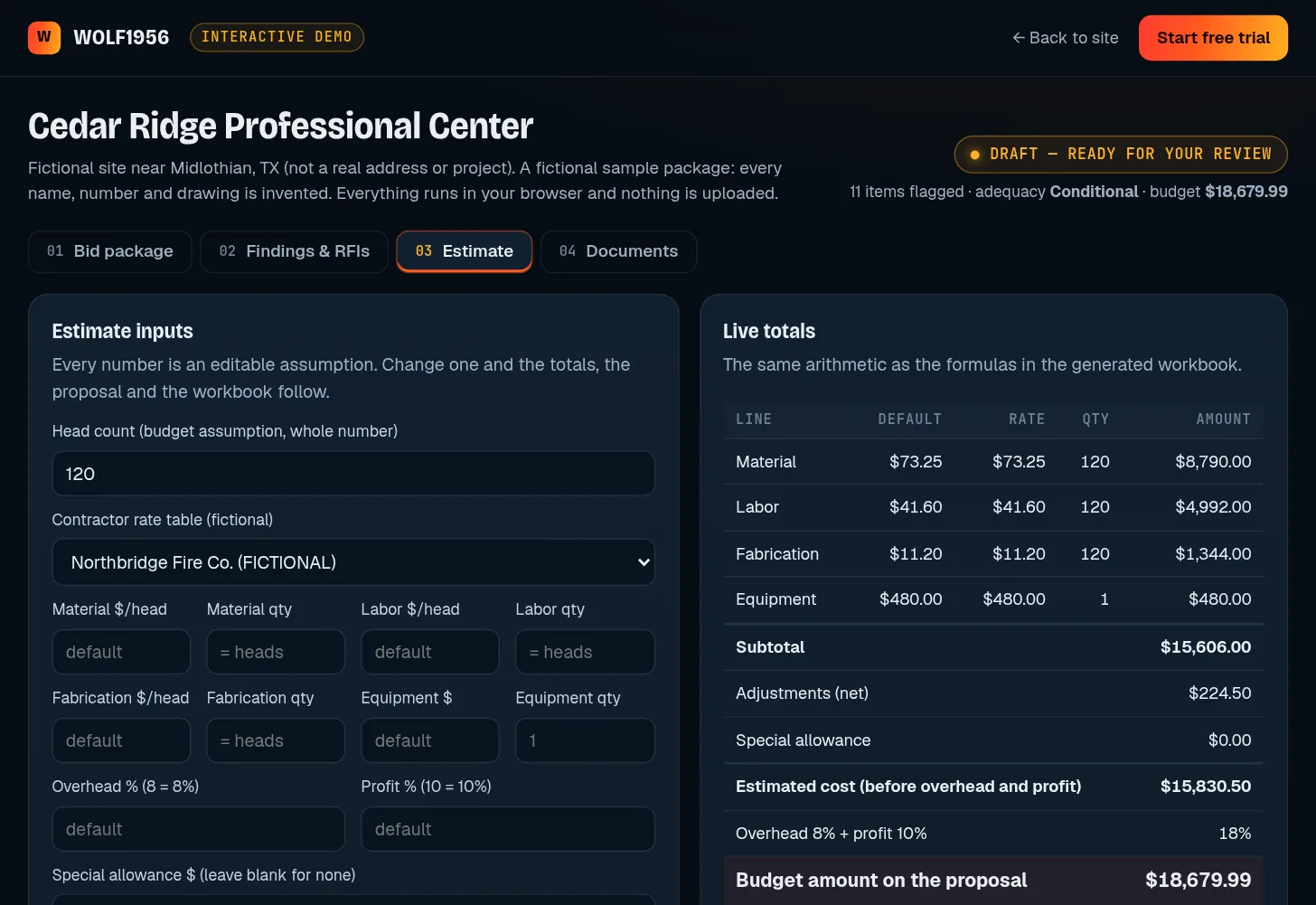
The required sprinkler scope, applicable codes and specs, assumptions, special conditions, exclusions, potential RFIs and missing information, all in one traceable sheet.
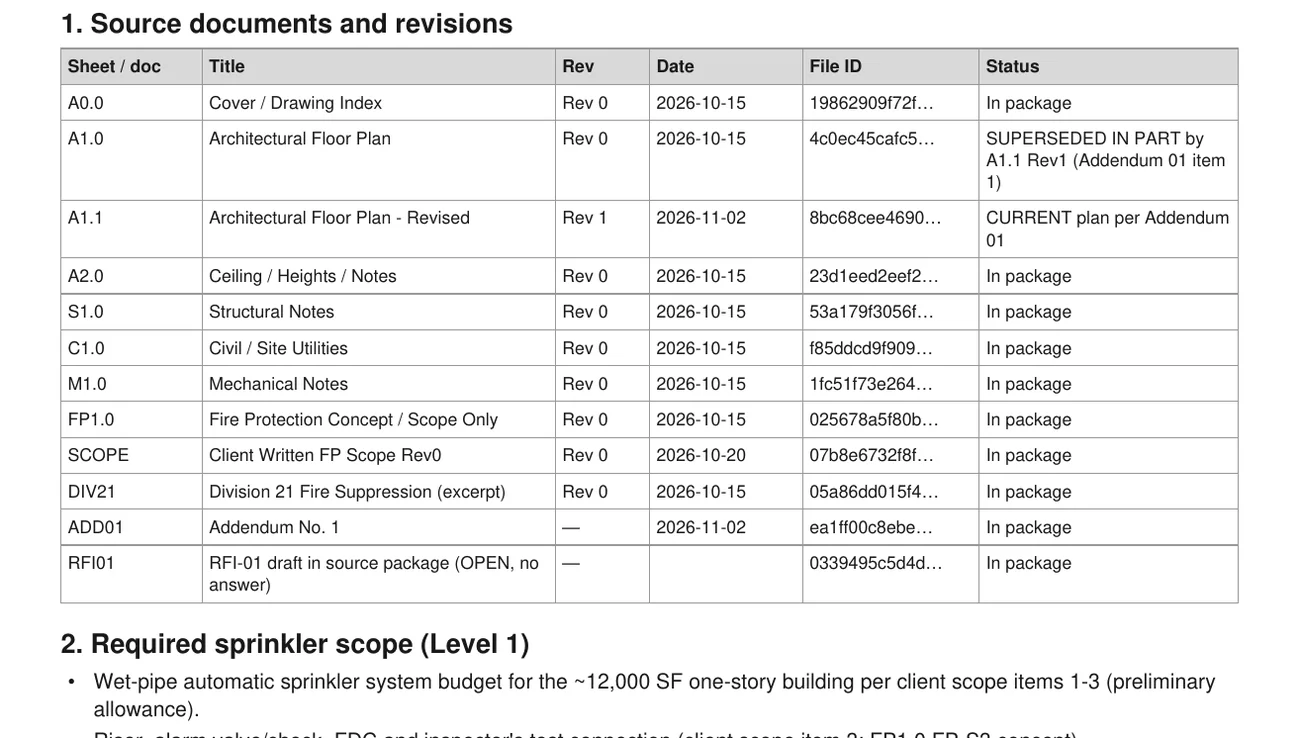
An editable estimate built on your contractor assumptions: quantities, labor, material, fabrication, equipment, overhead and profit. Change an input and it recalculates.
Try it: edit the fields on the sheet.
| Material | — |
|---|---|
| Labor | — |
| Riser / trim | — |
| Overhead & profit | — |
| Preliminary budget | — |
Not priced, pending clarification: underground (RFI-02), backflow (RFI-03), standpipe (RFI-04)
Fictional sample values, not pricing guidance.
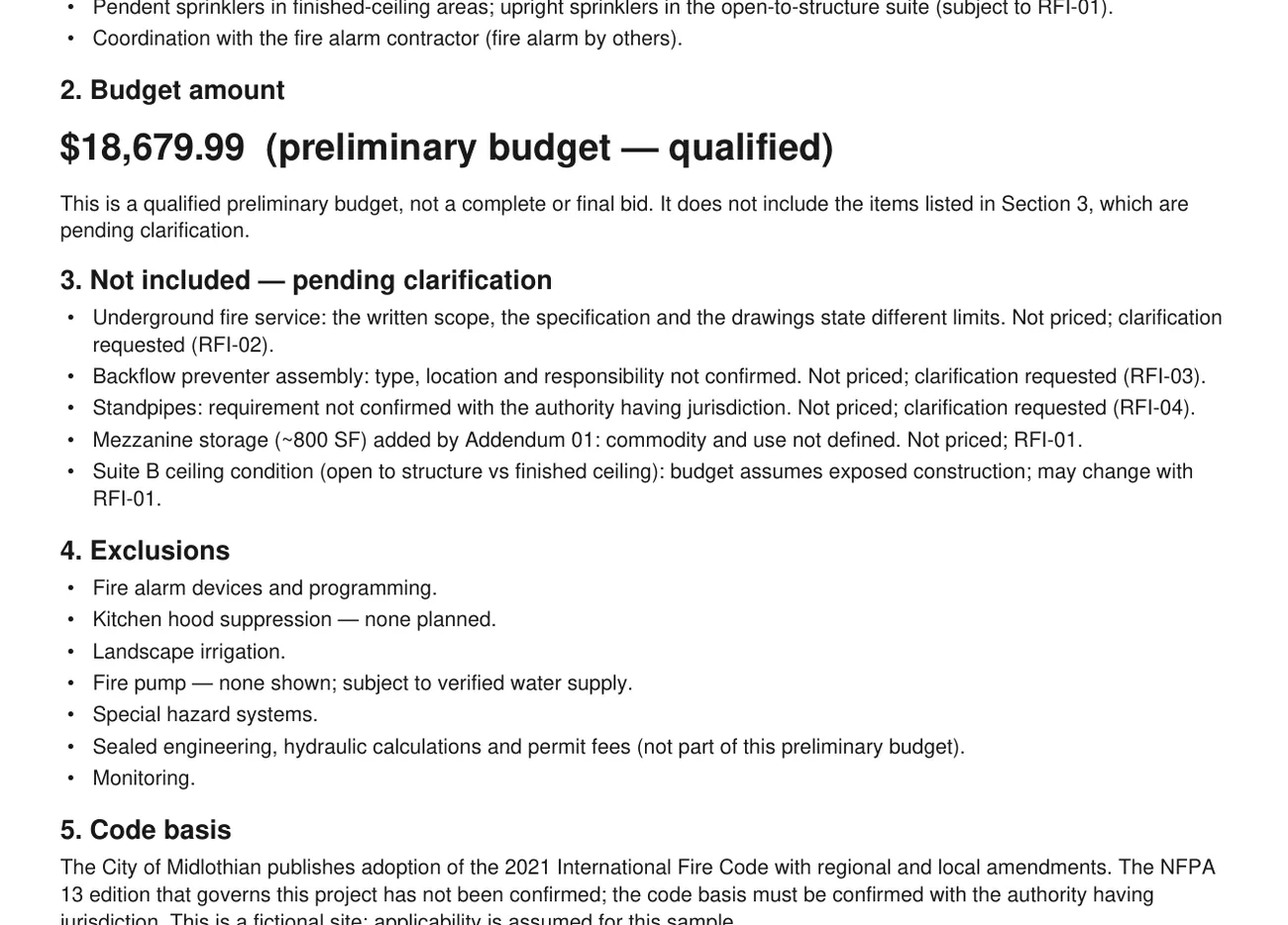
A clean, customer-facing proposal. Edit it freely or move it onto your own letterhead. Internal costs and markup never appear in it.
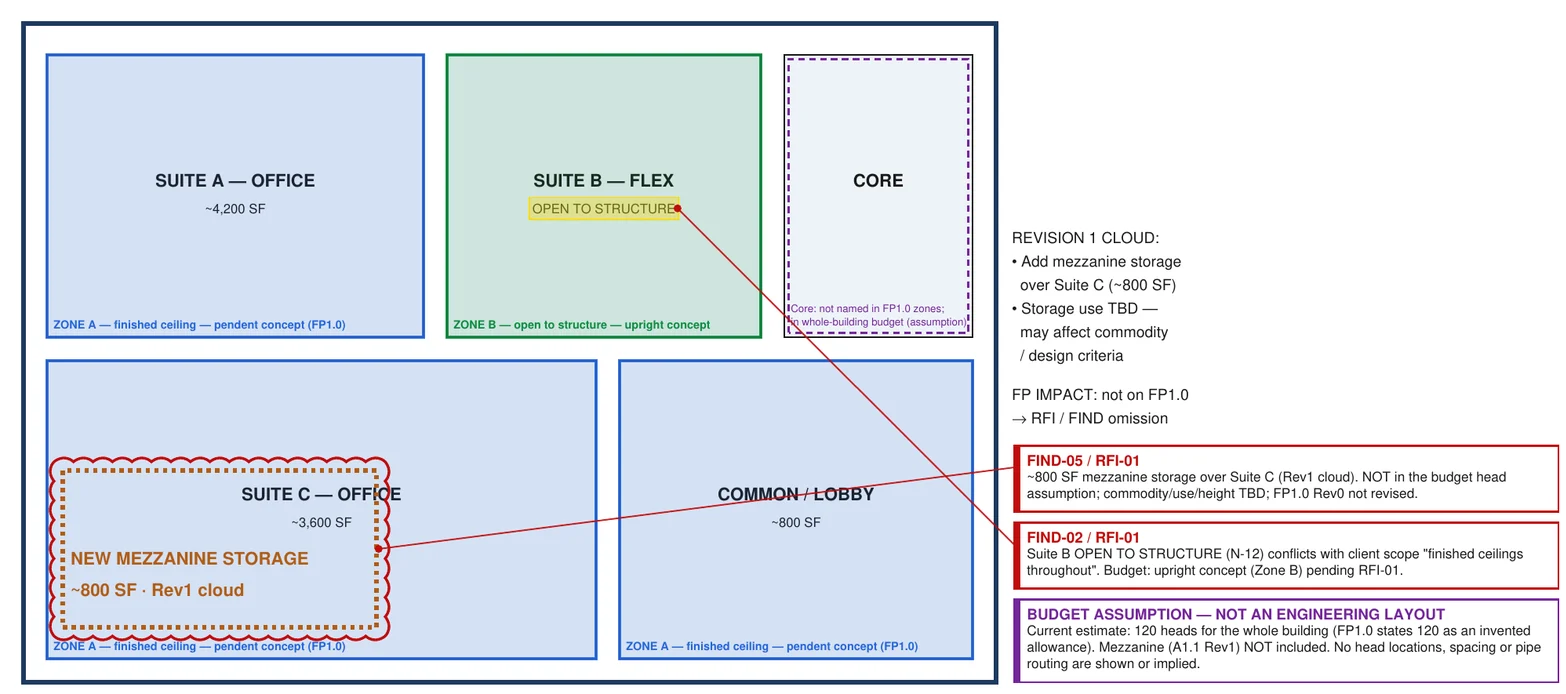
A separate annotated set showing scope areas, assumptions, discrepancies, possible omissions and clarification items, each referenced to the original sheet and revision.
Why a fire specialist
A general comparison with multi-trade AI takeoff software as a category. Individual products vary, and some include estimating and proposal features.
Who it’s for
Get support in early preconstruction, before sprinkler design is done, and on bid review when the full package lands.
Pressure-test fire protection scope, catch missing information early and bring a cleaner budget into the owner conversation.
Understand fire protection early, from architectural or schematic drawings and a written scope, before sprinkler drawings exist.
The rules we work by
Estimating is only as good as what it admits it doesn’t know. These rules are built into every review.
Why WOLF1956
WOLF1956 started with a career fire sprinkler estimator who spent years teaching estimating teams one habit above everything else: read the whole package before you put a number on it. WOLF1956 turns that discipline into a repeatable process, so every budget starts from the drawings, the specs, the code basis and the scope instead of a guess.


WOLF1956 was founded by John Elrod, bringing over 24 years of commercial fire protection experience in estimating, project management, business development, and executive leadership.
His experience includes major projects such as Grandscape, Espace, Texas Live!, the Dallas Convention Center, Equinix DA-11, and UT Southwestern Psychiatric Hospital.
John holds USACE QCQM certification, previously earned NICET Levels I–III, and completed CEF Design Levels I–IV.
WOLF1956 combines AI-powered estimating with real-world industry expertise. Every estimate is personally reviewed by John before release.
Pricing
No quote request and no demo call to find out what it costs. Your first project is free.
Every seat pays the plan price plus the $29.99 membership. Totals below update with seats.
Level 1
Up to 10 projects$249.99/ seat / month
Plus $29.99 / seat / month membership. Billed monthly. Renews automatically.
Monthly total: $279.98
Subscribe to Level 1Level 2
Up to 20 projects$699.99/ seat / month
Plus $29.99 / seat / month membership. Billed monthly. Renews automatically.
Monthly total: $729.98
Subscribe to Level 2Level 3
Up to 30 projects$1,299.00/ seat / month
Plus $29.99 / seat / month membership. Billed monthly. Renews automatically.
Monthly total: $1,328.99
Subscribe to Level 3Billing terms. Membership is $29.99 per seat per month. Each seat is also billed its plan price per month: Level 1 $249.99 (up to 10 projects), Level 2 $699.99 (up to 20 projects) or Level 3 $1,299.00 (up to 30 projects). Billing is recurring until cancelled. Cancel anytime, and cancellation stops your next renewal. You keep access through the end of the period you’ve already paid for. All payments are non-refundable, including partial months and unused seats.
FAQ
Yes. It’s built only for fire protection work: sprinkler scope, hazard classification, head counts, pipe, risers, FDC, backflow, water supply, standpipes and code basis. It isn’t a multi-trade takeoff tool, and that’s on purpose.
A generic takeoff tool counts and measures what’s drawn. A fire sprinkler budget also depends on things that usually aren’t drawn yet: hazard classification, water supply data, the adopted NFPA 13 edition, backflow type and who owns the underground. WOLF1956 checks those, flags what’s missing and drafts the RFIs, then builds the estimate.
Head counts by area and type, pipe footage by size, risers, valves, FDC and backflow, plus allowances for anything the package doesn’t show. On a preliminary budget without a sprinkler layout, head and pipe quantities are stated allowances based on area and hazard, and they’re labeled that way.
NFPA 13 and related standards such as NFPA 14 and NFPA 24 where they apply, along with the IFC and local amendments. Editions are cited from the project documents or the adopted code. If an edition or AHJ requirement can’t be confirmed, it stays flagged for you to verify.
No. It does the package reading and the first pass, and it shows its sources so your estimator can check every finding. Your rates, assumptions and final number stay yours.
No. A preliminary budget works from architectural construction drawings or schematic drawings together with a written fire protection scope. If the package isn’t enough for a meaningful budget, we tell you what’s missing instead of guessing.
No. It’s a preliminary budget built on stated assumptions, with pending items and exclusions listed. You stay in control of the final number, and every input is editable.
No. They’re an estimating and coordination aid that references your original sheets and revisions. They aren’t sealed engineering, shop drawings or permit documents.
It depends on the size and completeness of the package. When a complete package comes in, we give you a target date for that project. Incomplete packages need clarification first. We don’t promise a fixed turnaround.
Yes. The proposal is fully editable and transferable, and internal costs and markup never appear on it.
Your first project is free, with no card needed. After that, each seat is $29.99 per month for membership plus its plan: Level 1 $249.99 (up to 10 projects), Level 2 $699.99 (up to 20 projects) or Level 3 $1,299.00 (up to 30 projects), billed monthly on a recurring basis. Cancel anytime, and cancellation stops your next renewal. Payments are non-refundable, including partial months.
Files you send through the project upload page are kept private. They’re used only to prepare your documents, never used to train public AI models, never shared with other customers, and deleted on request.
No. The demo and every example on this page use a fictional project created for demonstration.
Get started
Your first project is free, with no card needed. Email us to start it and we’ll reply with how to send the package. Subscribe when you’re ready.
Request my free project See plansReady to send drawings? Please don’t attach them to email. Use the secure project upload instead.